
Organic Growth Trends in 2026: Strategies, Statistics & What Marketers Need to Know
Category: Digital Marketing
Reading Time: 8–10 minutes
Author: Bhumika Yadav
Organic growth has become one of the most valuable goals for modern businesses.
While paid advertising can generate quick visibility, organic marketing focuses on building long-term traffic, trust, engagement and brand recognition without paying for every click or impression.
In 2026, organic growth is changing significantly because of AI-powered search, short-form video, social media communities, helpful content and changing consumer behaviour.
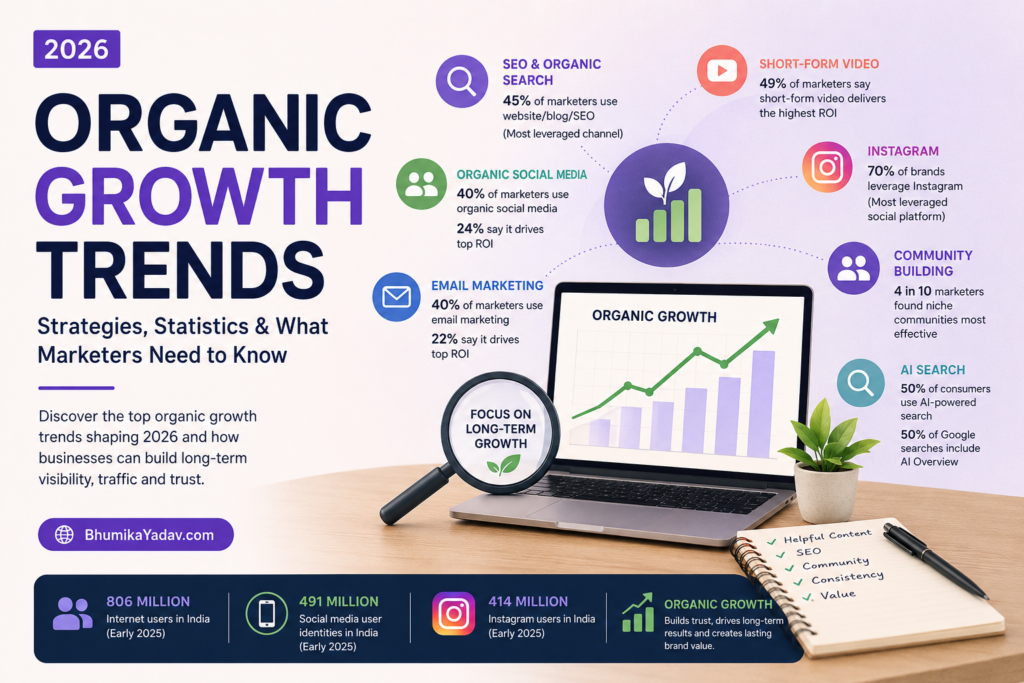
According to HubSpot’s 2026 State of Marketing research, website/blog/SEO is the most leveraged marketing channel, used by 45% of marketers, while organic social media is used by 40% of marketers.
This shows that organic marketing is not disappearing. Instead, it is becoming more strategic.
So, what are the biggest organic growth trends in 2026?
Let’s explore them.
What Is Organic Growth in Digital Marketing?
Organic growth refers to gaining visibility, traffic, engagement, leads or customers through unpaid marketing activities.
Examples include:
- SEO
- Blog content
- Organic social media
- YouTube content
- Email marketing
- Word-of-mouth referrals
- User-generated content
- Online communities
- Organic search
- Brand advocacy
For example, if someone searches Google for “best digital marketing strategies” and discovers your blog without you paying for that click, that is organic traffic.
Similarly, if someone discovers your Instagram account through a Reel, shares it with friends and follows your page without seeing a paid advertisement, that is organic social growth.
1. SEO and Organic Search Are Still Major Growth Drivers
One of the biggest misconceptions about digital marketing is that SEO is becoming irrelevant because of AI.
The reality is different.
SEO is evolving.
HubSpot’s 2026 State of Marketing report found that website/blog/SEO is the most leveraged marketing channel, used by 45% of marketers. It also ranked website/blog/SEO as the highest-ROI marketing channel, with 27% of marketers selecting it as one of their top ROI channels.
This means businesses still have a major opportunity to generate traffic through search.
However, modern SEO is no longer simply about inserting keywords into an article.
Successful SEO now requires:
- Search intent
- Helpful content
- Original insights
- Topic expertise
- Internal linking
- Technical SEO
- Mobile optimization
- Clear website structure
- Strong user experience
- Content that answers real questions
Key takeaway
SEO is not dead. Poor-quality SEO is.
Businesses should focus on creating content that genuinely helps users rather than producing articles only to rank for keywords.
2. AI Search Is Changing Organic Growth
AI-powered search is one of the biggest changes affecting organic marketing in 2026.
People are increasingly using AI tools to research questions, compare products and discover information.
According to HubSpot’s 2026 research, 50% of consumers use AI-powered search, while 50% of Google searches include an AI Overview. Additionally, 40.6% of marketers identify adapting SEO to changes in search as a major priority.
This means organic growth is expanding beyond traditional Google rankings.
Marketers now need to think about AEO — Answer Engine Optimization.
AEO focuses on creating content that is easy for AI-powered search systems to understand and use when answering questions.
How to prepare your content for AI search
Create content that:
- Answers specific questions.
- Uses clear headings.
- Provides original information.
- Includes statistics and credible sources.
- Demonstrates expertise.
- Uses simple and natural language.
- Covers a topic comprehensively.
Key takeaway
Don’t only ask:
“How do I rank on Google?”
Also ask:
“How can my content become the best answer to this question?”
3. Organic Social Media Is Becoming More Valuable
Social media is another major source of organic growth.
According to HubSpot’s 2026 data, 40% of marketers leverage organic social media content, making it the second-most leveraged channel after website/blog/SEO. Organic social media was also selected by 24% of marketers as one of their top ROI-driving channels.
This is particularly important for personal brands and small businesses because organic social media allows them to build an audience without requiring a large advertising budget.
Organic social growth can come from:
- Reels
- Carousels
- Educational posts
- Stories
- Comments
- Community engagement
- User-generated content
- Collaborations
- Personal storytelling
The important shift
The goal should not simply be:
“Get more followers.”
Instead:
Reach → Engagement → Trust → Community → Conversion
A smaller audience that trusts your brand can be more valuable than thousands of passive followers.
4. Instagram Is Becoming a Key Organic Growth Platform
Instagram continues to be a major platform for brand building.
HubSpot’s 2026 research found that 70% of brands leverage Instagram, making it the most leveraged social media platform among brands in the study.
India also has a massive Instagram audience.
DataReportal reported approximately 414 million Instagram users in India in early 2025, and Instagram’s potential advertising reach in India increased by approximately 51 million (+14%) between January 2024 and January 2025.
For marketers, this represents a huge opportunity.
Organic Instagram growth strategies
Reels:
Use short videos to reach new audiences.
Carousels:
Use educational content to encourage saves and shares.
Stories:
Show personality and build relationships.
Comments:
Participate in conversations within your niche.
Collaboration:
Partner with creators and complementary brands.
Educational content:
Answer questions your target audience frequently asks.
Key takeaway
Instagram growth is becoming less about simply posting attractive images and more about providing value and creating conversations.
5. Short-Form Video Is One of the Strongest Organic Content Formats
Short-form video has become one of the most powerful content formats for organic growth.
According to HubSpot’s 2026 State of Marketing data, 49% of marketers report short-form video as the content format generating the highest ROI, up from 24% in the previous year’s comparison.
That makes short-form video extremely important for marketers.
Examples include:
- Instagram Reels
- YouTube Shorts
- Educational videos
- Quick tutorials
- Industry tips
- Behind-the-scenes videos
- Myth-busting content
- Customer stories
A simple short-video formula
Hook → Problem → Value → Solution → CTA
For example:
“3 digital marketing mistakes that are killing your organic reach.”
Then explain the mistakes and finish with:
“Save this post for your next content strategy.”
Key takeaway
You don’t need expensive equipment to create useful videos.
A strong idea is more important than expensive production.
6. Educational Content Is Becoming a Strong Organic Growth Strategy
People don’t only use the internet to buy products.
They use it to learn.
This creates a major opportunity for businesses and personal brands.
Educational content can include:
- Tutorials
- How-to guides
- Industry insights
- Case studies
- Checklists
- Statistics
- Mistakes to avoid
- Beginner guides
- Expert opinions
Blog posts remain relevant as well. HubSpot’s 2026 research found that 23% of marketers report blog posts among their highest-ROI content formats, while small businesses are particularly likely to see ROI from blogging.
Example
Instead of creating:
“Our digital marketing services”
A business could create:
“10 Digital Marketing Strategies Every Small Business Should Try in 2026.”
The second approach can attract people who are actively searching for information.
Over time, useful content can introduce those readers to your brand.
Key takeaway
Teach first. Sell second.
7. Authenticity Is Becoming More Important in an AI-Saturated Internet
AI has made content creation faster.
But that has created another problem:
There is more generic content than ever.
HubSpot’s 2026 research found that 52% of marketers believe AI makes content so easy to create that it is becoming less effective overall, while 53% say they struggle to differentiate their content in an AI-saturated market.
This makes human perspective extremely valuable.
People want content that contains:
- Real experiences
- Personal opinions
- Original examples
- Genuine stories
- Expertise
- Personality
- Practical advice
Instead of:
“Here are five social media tips.”
Try:
“Here are the five social media strategies I would focus on if I were building a new personal brand today.”
The second feels more personal and distinctive.
Key takeaway
AI can help you create faster, but your perspective is what makes the content different.
8. Community Building Is Becoming a Major Organic Growth Strategy
Organic growth is increasingly moving from simply collecting followers to building communities.
Communities can exist through:
- Facebook Groups
- Email newsletters
- YouTube
- Niche online communities
HubSpot’s 2026 research found that 94% of teams diversified their marketing channels in the previous year, while 4 in 10 marketers said one of the most effective changes was moving from broad platforms toward niche communities.
This highlights an important trend:
Smaller, more relevant communities can sometimes create stronger relationships than large, broad audiences.
Key takeaway
Don’t just build an audience.
Build a community that cares about the topic you represent.
9. Email Marketing Remains an Important Organic Channel
Social media gets a lot of attention, but email remains valuable because businesses can communicate directly with subscribers.
HubSpot’s 2026 research lists email marketing among the most leveraged marketing channels at 40%, and it was selected by 22% of marketers as one of the top ROI-driving channels.
Email can be used for:
- Newsletters
- Educational content
- Product updates
- Offers
- Personal stories
- Industry insights
- Lead nurturing
The major advantage is that you are building an audience that you can communicate with directly rather than depending entirely on a social media algorithm.
Key takeaway
Social media helps you discover an audience. Email can help you retain that relationship.
10. Personal Branding Is Becoming an Organic Growth Asset
Personal branding has become increasingly important for freelancers, entrepreneurs, consultants and digital marketers.
People often want to know:
Who is behind the brand?
A strong personal brand can communicate:
- Expertise
- Personality
- Experience
- Values
- Knowledge
- Credibility
For someone building a career in digital marketing, organic personal branding can involve:
- Sharing marketing insights
- Posting educational content
- Creating case studies
- Discussing industry trends
- Sharing projects
- Publishing blogs
- Building a professional LinkedIn presence
- Creating short-form videos
Over time, consistent content can make your name associated with a particular area of expertise.
Organic Growth Statistics at a Glance
| Organic Growth Trend | 2026 Statistic |
|---|---|
| Website/Blog/SEO usage | 45% of marketers |
| Organic social media usage | 40% of marketers |
| Email marketing usage | 40% of marketers |
| Instagram brand usage | 70% of brands |
| Website/Blog/SEO top ROI channel | 27% |
| Organic social media top ROI channel | 24% |
| Short-form video top ROI content format | 49% |
| Consumers using AI-powered search | 50% |
| Google searches with AI Overview | 50% |
| Indian internet users | 806 million in early 2025 |
| Indian social media user identities | 491 million in early 2025 |
| Instagram users in India | 414 million in early 2025 |
Sources: HubSpot State of Marketing 2026 and DataReportal Digital 2025: India. Statistics use the reporting periods and methodologies specified by the original sources.
Organic Growth vs Paid Growth
Organic and paid marketing should not always be treated as competitors.
They can work together.
| Organic Growth | Paid Growth |
|---|---|
| Builds gradually | Can generate faster reach |
| Focuses on long-term visibility | Focuses on immediate distribution |
| SEO | Search ads |
| Organic social | Paid social |
| Blogs | Display advertising |
| Community | Sponsored campaigns |
| Paid lead generation | |
| Referrals | Retargeting |
A strong marketing strategy can combine both.
For example:
Organic content → audience engagement → retargeting → conversion
The key is understanding what your business actually needs.
How to Build an Organic Growth Strategy in 2026
If you are starting from zero, don’t try to do everything at once.
Follow a simple framework.
Step 1: Choose Your Audience
Clearly define who you want to reach.
Step 2: Choose Your Main Platform
Start with one or two platforms instead of trying to be everywhere.
Step 3: Create Content Pillars
For example:
Education + Trends + Tips + Personal Experience
Step 4: Publish Consistently
Consistency is more sustainable than randomly posting large amounts of content.
Step 5: Optimize for Search
Use relevant keywords, clear headings and useful answers.
Step 6: Encourage Engagement
Ask questions, respond to comments and participate in relevant conversations.
Step 7: Track Your Results
Monitor:
- Organic traffic
- Search impressions
- Click-through rate
- Followers
- Engagement
- Saves
- Shares
- Leads
- Conversions
Step 8: Improve What Works
If a particular topic consistently performs well, create more content around that topic.
The Future of Organic Growth
Organic growth in 2026 is not about finding one secret algorithm hack.
It is about building a system.
The strongest organic strategies combine:
SEO + Helpful Content + AI Search Optimization + Social Media + Video + Community + Email + Personal Branding
The businesses and creators who succeed will likely be those who focus less on chasing temporary trends and more on building valuable digital assets that continue generating attention over time.
A helpful blog post can bring search traffic months after publication.
A useful Reel can continue receiving views.
A newsletter can build long-term relationships.
A strong personal brand can create opportunities beyond a single campaign.
That is the real power of organic growth.
Final Thoughts
Organic growth takes patience, but its long-term value can be significant.
In 2026, the biggest opportunities are not simply about publishing more content. They are about creating better, more useful and more authentic content.
SEO remains a powerful channel. Organic social media continues to matter. Short-form video has become a major ROI-driving format. AI search is changing how people discover information, while communities and personal brands are becoming increasingly important.
The most important lesson is simple:
Don’t create content just to be visible. Create content that is worth discovering.
When you consistently provide value, answer questions, understand your audience and build trust, organic growth becomes more than a marketing tactic.
It becomes a long-term digital asset.
Frequently Asked Questions
What is organic growth in digital marketing?
Organic growth is the process of gaining traffic, visibility, engagement, leads or customers through unpaid channels such as SEO, organic social media, blogs, email, referrals and community building.
Is organic marketing still effective in 2026?
Yes. HubSpot’s 2026 research shows that website/blog/SEO is the most leveraged marketing channel at 45%, while organic social media is used by 40% of marketers.
What is the best organic growth strategy?
There is no single strategy that works for every business. A strong starting point is a combination of SEO, helpful content, social media, short-form video, community engagement and email marketing.
How long does organic growth take?
Organic growth usually takes longer than paid advertising because it depends on building visibility, trust and authority. Results can vary depending on the industry, competition, content quality and consistency.
Is blogging still useful in 2026?
Yes. Blog content remains an important part of organic search and can help businesses answer customer questions, demonstrate expertise and generate long-term search traffic.
What is AEO?
AEO stands for Answer Engine Optimization. It involves creating content that is structured and useful enough to be understood and potentially surfaced by AI-powered search and answer engines.
About the Author
Bhumika Yadav is a digital marketer passionate about digital marketing, creative strategy, content creation and building meaningful digital experiences.
Through BhumikaYadav.com, she shares practical insights, trends and ideas to help people understand the constantly changing world of digital marketing.
Want to learn more about digital marketing? Explore more articles on BhumikaYadav.com.